




Subscribe
It’s easy to assume we all agree on what fairness means. But that’s not the case. An umpire’s call may seem fair to one baseball fan but not another; that’s just the way of it.
Its contextual nature is exactly what makes fairness so hard to define, said Chris Rider, Thomas C. Kinnear Professor and Associate Professor of Entrepreneurial Studies, Ross School of Business, University of Michigan. People often get lost in differing definitions of fairness, he explained, and it gets in the way of real improvements for people. The way forward is to focus on what we already can agree on.
But that doesn’t make equity any less of a worthwhile pursuit.
“Equity is a universal and timeless aspiration,” said Rider.
Rider spoke with Delve during his recent trip to Montreal, where he joined Lisa Cohen and HeeJung (HJ) Jung, two Associate Professors in Organizational Behaviour at McGill University, to hold the 3rd Equitable Opportunity Conference in May of 2026. The event gathered global researchers from across disciplines to explore this year’s theme of “diagnosing and addressing inequality mechanisms.”
“We want to explicitly consider those different notions of fairness, to identify where we might actually have some common ground,” said Rider.
Take track and field, he explained. Differential treatment is built into the 400-metre race. Even though the race has a single finish line, runners in different lanes are expected to start at different points because the track’s curvature adds distance. Nobody objects to this practice. The 100-metre race, however, is held on the straight edge, such that differential treatment wouldn’t be appropriate at all.
Two different races on the same track. One with differential treatment, one without, and yet both feel fair. This is the common ground these researchers want people to see. A practice that is equitable in one context won’t be in another, but despite this shifting standard, people can still agree on where the track curves and where it doesn’t.
Central to this research is the question every organization must ask: where is the 400-metre curve? Where does unfairness already exist, plain enough that people can agree if they only knew where to look?
A framework for equitable opportunity
By focusing on mechanisms – the tangible, everyday processes and systems inside an organization – leaders can easily find agreement about where unfairness exists before even deciding how to address it, said Rider. This was the ethos of the conference: a shift in EDI practices from acknowledging a gap between two groups to understanding the actual mechanism that produces it.
For example, hiring diverse people into an organization without equitable promotion opportunities doesn’t eliminate disparity, said Rider. Addressing that would require looking at the structures and mechanisms that generate promotional disparity in the first place.
To identify such mechanisms, Rider developed “the equity analytics framework” alongside Ray Reagans, the Alfred P. Sloan Professor of Management at the MIT Sloan School of Management. It’s a 2×2 matrix that helps break down an organization’s processes and how they affect employees.
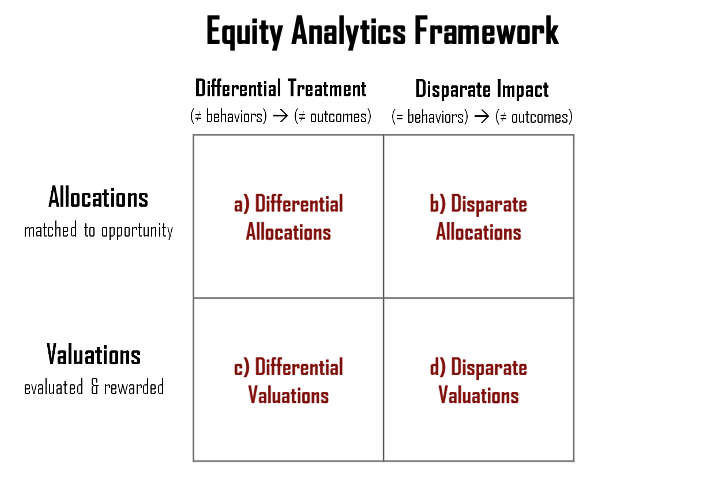
Equity Analytics Framework figure courtesy of Professor Chris Rider.
Organizational processes are divided into two categories. Allocations distribute opportunities like jobs or projects. Valuations assess people’s contributions through methods like performance evaluations.
Drawing on concepts from employment discrimination law, disparities can then result from those processes in one of two ways. Differential treatment occurs when an organization treats people differently within a given context. Disparate impact means people are treated equivalently but with differing outcomes.
The work of equity analytics is in situating an observed disparity at the intersection of a process (allocation or valuation) and a form of treatment (differential or disparate). This diagnostic work makes an organization’s disparities visible and, consequently, its opportunities to be more equitable.
As Rider sees it, the beauty of this framework is that an organization only needs to agree that a disparity exists in one square of the matrix to have an immediate avenue for improvement. Success doesn’t depend on solving everything at once.
“We have many opportunities … as leaders of organizations to be more equitable than we currently are,” said Rider.
Looking at their own processes and working on just one of these opportunities is enough for an organization to get the ball rolling.
Diversity of solutions
Once the mechanism behind a disparity is understood, it’s easier to design an appropriate solution. A problem rooted in differential allocation calls for a different intervention than one driven by disparate valuations. This is where many organizations go wrong: not in their commitment to EDI, but in adopting the wrong solution for the problem they have, said Rider. And it’s leading to fatigue and failure around current initiatives.
According to Cohen, the most popular EDI initiatives are also among the least effective.
“There is a fair amount of research on what works and what doesn’t work around EDI,” she said. “So many of the programs everyone thinks are great for EDI don’t do a thing.”
Nearly half of midsize companies and practically all Fortune 500 companies use diversity training to reduce bias in hiring, performance ratings, and other workplace processes. However, evidence suggests that these trainings fail to improve managerial representation for minority groups.
Mentoring programs, on the other hand, can be far more effective, said Cohen.
Coca-Cola’s own mentoring program, implemented after a race discrimination lawsuit, had a positive impact on the company’s demographic makeup. After five years, 80 per cent of mentees had been promoted, and representation of salaried employees in minority groups increased by as much as 3.3 per cent in six years.
Job design can also support equity. Research by Cohen and Sara Mahabadi, Assistant Professor at the Alberta School of Business, shows that a job is still being shaped while candidates are considered. For example, some employers use the hiring process itself to clarify the organization’s needs and define a new position accordingly.
In the language of the equity analytics framework, this produces a disparate allocation of jobs. Candidates are evaluated under equivalent hiring criteria, yet the job’s mutability produces different outcomes. Different groups also respond differently to job-posting requirements, Cohen said. Women and people of colour have been shown to apply more cautiously, often only to positions for which they are an exact match, while white men are more likely to apply regardless of how closely they fit the description. Candidates who take a job posting at face value may self-select out, unknowingly disadvantaging .
Similarly, when entrepreneurial founding teams assign task positions among themselves, they rely on both diffuse status cues, such as gender or ethnicity, as well as expertise cues. Jung’s research found that the person who often becomes CEO reflects perceived high status as much as relevant ability. This imbalanced valuation of status against expertise again leads to an allocation disparity.
But if a job can be built rather than given, it can also be rebuilt. This presents firms with a clear opportunity: rather than expecting applicants to get savvier about the inner workings of the hiring process, organizations design and allocate positions more equitably. A simple example is flexible work-from-home arrangements that support employees with caregiver obligations.
Effective, research-backed EDI tools already exist; organizations just need to better apply them, said Cohen.
For scholars like Cohen, Jung, and Rider, this isn’t a moral debate. People in organizations fundamentally want to be fair, said Rider. They just need more help in understanding what that truly looks like in practice.
“We can put our differences in ethics aside, and gather some momentum in one place, and maybe we realize we have more in common than we thought,” he said.
Featured experts

Lisa Cohen
Associate Professor, Organizational Behaviour, McGill University

Chris Rider
Thomas C. Kinnear Professor and Associate Professor of Entrepreneurial Studies, Ross School of Business, University of Michigan
Written by:
Edie Pearman, Content Assistant, McGill Delve
The cover image for this article was generated using AI.